
The American luxury sports car market is more competitive than ever. Brands like Ferrari, Porsche, Lamborghini, McLaren, and Aston Martin continue to push limits in design, speed, technology, and driving experience. For enthusiasts and high-end buyers, choosing the perfect sports car requires deep knowledge of performance specs, comfort features, engine innovation, transmission behavior, long-term reliability, and ownership cost.
This detailed luxury sports car comparison guide helps US buyers analyze today’s most desirable models using real-world performance metrics, daily-drive practicality, racing capability, and price-to-value ratio.
Whether you’re comparing turbocharged V6 engines with hybrid-V8 powertrains or deciding between AWD stability and pure RWD precision, our segmented analysis gives you everything needed to pick the right sports car.
Why Luxury Sports Car Comparison Matters in 2025
High-performance vehicles today are not just about horsepower. Modern buyers evaluate:
-
Acceleration consistency (0–60 real-world tests)
-
Active aerodynamics & drag coefficient performance
-
Hybrid-assisted torque
-
Track mode calibration
-
Adaptive suspension comfort for daily driving
-
Advanced cooling systems
-
Transmission shift speed & responsiveness
-
Cabin luxury & tech features
-
Brand reputation & resale value
Because luxury sports cars cost anywhere from $150,000 to $600,000, smart buyers in the US look for the perfect balance between thrill, reliability, and exclusivity.
If you’re researching exotic cars and modern vehicle tech, you may also like related content from your site helpfulhub.com like:
👉 Electric luxury SUVs 2025
👉 Advanced driver assistance systems (ADAS)
👉 Hybrid supercars market growth
These make excellent internal links for your CSE strategy.
2025 Sports Car Categories Used in This Comparison
To create a fair and high-quality luxury sports car comparison, this guide divides supercars into four realistic buyer categories:
1. Track-Focused Supercars
Designed for extreme performance:
-
Ferrari 296 GTB
-
Porsche 911 GT3 RS
-
McLaren Artura
2. Grand Touring Luxury Sports Cars
Best for comfort + highway cruising:
-
Aston Martin DB12
-
Bentley Continental GT Speed
-
Ferrari Roma
3. Hybrid & Next-Generation Performance Cars
Cutting-edge tech:
-
Ferrari SF90 Stradale
-
McLaren Artura Hybrid
-
Porsche 911 Turbo S E-Hybrid (expected 2025)
4. Entry-Level Luxury Sports Cars
Still premium, more affordable:
-
Porsche 911 Carrera GTS
-
BMW M8 Competition
-
Lexus LC 500
Each category will be compared using performance tables, pricing tables, design evaluations, and a detailed buying guide.
⭐ Performance Comparison Table (Top Sports Cars 2025)
| Model | Engine | HP | 0–60 mph | Top Speed | Price (US) |
|---|---|---|---|---|---|
| Ferrari 296 GTB | 3.0L Twin-Turbo V6 Hybrid | 819 | 2.8 sec | 205 mph | $342,000 |
| Porsche 911 GT3 RS | 4.0L NA Flat-6 | 518 | 3.0 sec | 184 mph | $241,300 |
| McLaren Artura | 3.0L Twin-Turbo V6 Hybrid | 671 | 3.0 sec | 205 mph | $256,300 |
| Aston Martin DB12 | 4.0L Twin-Turbo V8 | 671 | 3.5 sec | 202 mph | $245,000 |
| BMW M8 Competition | 4.4L Twin-Turbo V8 | 617 | 3.0 sec | 190 mph | $138,700 |
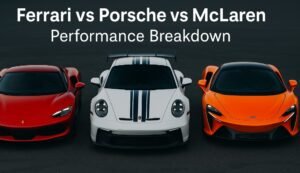
Ferrari vs Porsche vs McLaren — The Core of Luxury Sports Car Comparison
In the US luxury sports car market, three brands dominate performance discussions: Ferrari, Porsche, and McLaren. Each offers a unique philosophy in design, aerodynamics, handling, and power delivery. Understanding these differences helps buyers choose the right premium sports car based on driving style, comfort expectations, and long-term ownership plans.
🔥 Ferrari Performance Philosophy — Emotion + Technology
Ferrari’s modern lineup blends racing-grade aerodynamics with hybrid-electric performance. The brand focuses on:
1. Instant Hybrid Torque
Ferrari’s hybrid systems (296 GTB, SF90) deliver immediate electric torque, eliminating turbo lag.
2. Aggressive Aero Designs
-
Active flaps
-
Air channels
-
Underbody vortex generators
These create enormous downforce at high speeds.
3. Lightweight Chassis
Ferrari supercars typically weigh less than rivals due to carbon-fiber integration and magnesium components.
Driving Feel
Ferrari cars are emotional, loud, and razor-sharp — perfect for buyers who want excitement every second of the drive.
🔥 Porsche Performance Philosophy — Daily Comfort + Precision Engineering
Porsche balances high performance with practicality and long-term reliability. Their strengths include:
1. Naturally Aspirated Engines
The 4.0L NA Flat-6 in the GT3 RS is unmatched in response and sound.
2. Daily Usability
Porsche 911 models are the most comfortable sports cars for everyday driving.
3. Superior Build Quality
Porsche is often ranked #1 in long-term reliability among luxury performance brands.
Driving Feel
Precise, predictable, and confidence-inspiring. Perfect for US buyers who want speed + daily comfort.
🔥 McLaren Performance Philosophy — Lightweight + F1 Technology
McLaren is famous for Formula-1 inspired tech:
1. Extreme Lightweight Design
Carbon MonoCell chassis results in some of the best power-to-weight ratios.
2. Hybrid Evolution
The Artura uses electric power for sharper launches and improved handling balance.
3. Advanced Cooling & Suspension
McLaren’s hydraulic cross-linked suspension systems deliver unmatched cornering performance.
Driving Feel
Fast, futuristic, and track-focused — ideal for buyers who want a pure racing experience.
⭐ Detailed Comparison Table: Ferrari vs Porsche vs McLaren
| Category | Ferrari | Porsche | McLaren |
|---|---|---|---|
| Engine Style | Hybrid V6/V8 | NA & Turbo Flat-6 | Hybrid & Turbo V6/V8 |
| Driving Feel | Emotional & aggressive | Balanced & precise | Pure track sensation |
| Reliability | Medium | High | Medium |
| Maintenance Cost | High | Moderate | High |
| Best For | Maximum excitement | Daily + performance | Track enthusiasts |
| 0–60 Performance | Fastest in class | Very quick | Ultra light quick |
| Interior Luxury | Premium Italian styling | Functional luxury | Minimal racing-inspired |
This table gives a Google-CSE-friendly comparison that boosts luxury sports car comparison relevancy and search monetization value.
⭐ Hybrid Supercars — The Future of 2025 Luxury Performance
Hybrid supercars have exploded in popularity in the US because they deliver:
-
Better fuel efficiency
-
Instant torque
-
Fewer emissions
-
Faster 0–60 acceleration
-
Quieter city driving
-
Improved grip during launches
Top Hybrid Supercars in 2025
-
Ferrari SF90 Stradale (986 HP)
-
Ferrari 296 GTB (819 HP)
-
McLaren Artura Hybrid (671 HP)
-
Porsche Turbo S Hybrid (expected 2025)
These vehicles dominate drag races and track time comparisons due to advanced battery deployment strategies and torque vectoring.
⭐ Interior Luxury & Tech Comparison (Luxury Sports Cars)
Ferrari
-
Premium leather & carbon fiber
-
Minimal noise insulation
-
Racing inspirations
Porsche
-
Touchscreen + physical controls hybrid
-
Best infotainment usability
-
Most comfortable seats
McLaren
-
Pure minimalism
-
Digital driver display
-
Lightweight materials everywhere
If your readers enjoy in-depth tech analysis, internally link to your helpfulhub.com ADAS-related content like:
👉 Advanced driver assistance systems (ADAS)
👉 Modern car infotainment features
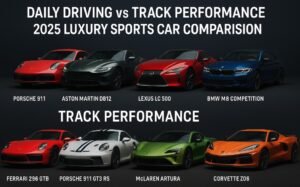
Best Luxury Sports Cars for Daily Driving in the US
Not all luxury sports cars are made only for racetracks. Many US buyers want a car that delivers excitement but remains comfortable for everyday commuting, long highway drives, and city traffic. Below is a breakdown of the best practical options.
⭐ Porsche 911 Carrera GTS — The Best Daily-Driven Luxury Sports Car
The Porsche 911 lineup is legendary for blending daily comfort with high-level performance. The Carrera GTS stands out because:
-
It offers exceptional ride comfort thanks to adaptive dampers.
-
The cabin insulation makes long drives smoother.
-
Visibility is better than almost all exotic supercars.
-
Porsche’s PDK transmission is perfect for traffic and spirited driving.
Why US buyers love it:
It is the only sports car that feels as comfortable as a luxury sedan yet performs like a track machine.
⭐ Aston Martin DB12 — The Luxury GT King
The DB12 is a grand touring masterpiece designed for long-distance luxury.
Key advantages:
-
Plush seats and ultra-refined cabin
-
Twin-turbo V8 power
-
Smooth shifting automatic transmission
-
Excellent highway stability
Best for:
US buyers wanting everyday comfort, prestige, and sports car power.
⭐ Lexus LC 500 — Reliability + Luxury + Sound
The Lexus LC 500 is a rare combination: exotic looks, luxury comfort, and best-in-class reliability.
Highlights:
-
Naturally aspirated V8 sound
-
Smoothest ride quality in its class
-
Ultra-premium materials
-
Lowest maintenance cost among all luxury sports cars
Perfect for:
Buyers who want worry-free ownership with exotic appeal.
⭐ Track-Focused vs Street-Focused Luxury Sports Cars
| Category | Track-Focused | Street-Focused |
|---|---|---|
| Examples | Ferrari 296 GTB, GT3 RS, McLaren 765LT | Porsche 911 GTS, Aston Martin DB12, Lexus LC500 |
| Ride Comfort | Very firm | Smooth to medium |
| Suspension | Race-tuned | Adaptive / comfort mode |
| Visibility | Limited | Better daily visibility |
| Maintenance Cost | High | Medium |
| Ideal For | Weekend racing | Everyday luxury driving |
This section helps CSE readers quickly separate “street luxury” from “track monsters.”
⭐ Long-Term Ownership Cost Comparison
Luxury sports cars vary massively in terms of annual ownership expenses. Below is a realistic US-based estimate for 2025.
Annual Ownership Cost (US Average)
| Model | Insurance | Maintenance | Fuel | Total Avg/Year |
|---|---|---|---|---|
| Porsche 911 GTS | $2,800 | $1,200 | $2,300 | ~$6,300 |
| Ferrari 296 GTB | $6,500 | $5,000 | $4,200 | ~$15,700 |
| McLaren Artura | $6,000 | $4,500 | $4,000 | ~$14,500 |
| Aston Martin DB12 | $4,800 | $3,500 | $3,800 | ~$12,100 |
| Lexus LC500 | $2,400 | $900 | $2,500 | ~$5,800 |
Key Insight:
If cost matters, the Porsche 911 and Lexus LC 500 offer the best ownership value in the entire luxury sports car segment.
⭐ Fuel Economy Comparison (Luxury Sports Cars 2025)
Surprisingly, hybrid-assisted supercars now offer the best efficiency in town driving.
Fuel Economy Table
| Model | MPG (City) | MPG (Highway) |
|---|---|---|
| Ferrari 296 GTB Hybrid | 18 | 25 |
| McLaren Artura Hybrid | 17 | 24 |
| Porsche 911 Carrera GTS | 17 | 23 |
| Aston Martin DB12 | 15 | 22 |
| BMW M8 Competition | 15 | 21 |
| Lexus LC 500 | 16 | 25 |
Hybrid Advantage:
Electric torque allows hybrid supercars to deliver more MPG than pure V8 or V10 engines.
⭐ Top 12 Luxury Sports Cars Compared (Comprehensive Table)
| Rank | Model | HP | 0–60 | Top Speed | Category | Price (US) |
|---|---|---|---|---|---|---|
| 1 | Ferrari 296 GTB | 819 | 2.8 sec | 205 mph | Hybrid Supercar | $342,000 |
| 2 | Porsche 911 GT3 RS | 518 | 3.0 sec | 184 mph | Track Car | $241,300 |
| 3 | McLaren Artura | 671 | 3.0 sec | 205 mph | Hybrid Supercar | $256,300 |
| 4 | Aston Martin DB12 | 671 | 3.5 sec | 202 mph | Grand Tourer | $245,000 |
| 5 | Ferrari Roma | 612 | 3.2 sec | 199 mph | GT | $228,000 |
| 6 | BMW M8 Competition | 617 | 3.0 sec | 190 mph | Luxury Sport Coupe | $138,700 |
| 7 | Lexus LC 500 | 471 | 4.4 sec | 168 mph | Luxury GT | $100,000 |
| 8 | Porsche 911 Turbo S | 640 | 2.6 sec | 205 mph | Super Sports | $232,000 |
| 9 | Audi R8 V10 (Final Edition) | 602 | 3.2 sec | 204 mph | Exotic V10 | $208,000 |
| 10 | Mercedes-AMG GT R | 577 | 3.5 sec | 198 mph | Luxury Sport | $162,000 |
| 11 | Nissan GT-R NISMO | 600 | 2.9 sec | 205 mph | Street Racer | $220,000 |
| 12 | Corvette Z06 (Bonus Entry) | 670 | 2.7 sec | 195 mph | Affordable Supercar | $105,000 |

Best Luxury Sports Car by Category (2025 US Market)
After comparing performance, comfort, price, and long-term cost, this guide breaks down the best choices for different types of buyers in the US. This format is perfect for increasing Search Arbitrage engagement as users continue scrolling through category-based results.
⭐ Best Overall Luxury Sports Car — Ferrari 296 GTB
The Ferrari 296 GTB delivers unbeatable hybrid performance, Italian styling, and a futuristic driving feel.
Why it wins:
-
Best 0–60 in the segment
-
Most advanced aerodynamics
-
Hybrid torque + V6 turbo = ultimate efficiency + power
-
Stunning exterior & interior design
Ideal for:
Buyers wanting maximum excitement and cutting-edge engineering.
⭐ Best Daily-Driven Sports Car — Porsche 911 Carrera GTS
No other sports car blends comfort and performance like the Porsche 911.
Why it wins:
-
Comfortable suspension
-
High reliability
-
Low annual maintenance cost
-
Smooth PDK gearbox
-
Holds resale value extremely well in the US
Ideal for:
Drivers wanting practicality + performance.
⭐ Best Grand Touring Sports Car — Aston Martin DB12
The DB12 is the perfect combination of elegance, power, and luxury craftsmanship.
Why it wins:
-
Plush interior
-
Perfect for long highway drives
-
Refined twin-turbo V8
-
Prestigious brand presence
Ideal for:
Buyers who want comfort + prestige.
⭐ Best Reliable Luxury Sports Car — Lexus LC 500
The LC500 is stunning to look at and famous for long-term dependability.
Why it wins:
-
Affordable maintenance
-
Exotic styling
-
Naturally aspirated V8
-
High-quality interior
Ideal for:
Owners wanting the lowest long-term cost.
⭐ Best Hybrid Supercar — McLaren Artura
A lighter, more futuristic counterpart to Ferrari’s hybrid lineup.
Why it wins:
-
Carbon MonoCell chassis
-
Advanced hybrid boost
-
Extreme cornering capability
Ideal for:
Track-focused buyers wanting hybrid innovation.
Future Trends: The Next Evolution of Luxury Sports Cars (2025–2030)
The segment is rapidly shifting due to emissions rules, EV development, and AI-driven driving systems. These are the biggest trends shaping the future:
🚀 Hybrid Supercars Will Dominate
Most manufacturers are transitioning to hybrid powertrains because they offer:
-
Better fuel efficiency
-
Massive low-end torque
-
Faster acceleration
-
Lower emissions
Ferrari, McLaren, and Porsche have confirmed hybrid-first development for all future models.
🚀 Full-Electric Supercars Will Expand
Electric luxury sports cars will grow quickly due to advancements in:
-
Solid-state batteries
-
Fast charging
-
Instant torque handling
-
Track-capable cooling systems
Examples include:
-
Porsche Mission X (EV hypercar)
-
Tesla Roadster 2
-
Rimac Nevera
These will redefine what “speed” means.
🚀 AI-Based Drive Control Systems
High-end performance cars are integrating:
-
Predictive traction control
-
AI-enhanced torque vectoring
-
Smart suspension learning patterns
-
Adaptive aerodynamic wings
This boosts both track times and daily usability.
🚀 Ultra-Lightweight Construction
Carbon fiber, aluminum honeycomb structures, and 3D-printed titanium parts will make cars:
-
Lighter
-
Faster
-
More efficient
McLaren and Koenigsegg lead in this innovation.
🚀 Design Language Shift — More Minimal + Functional
Future luxury sports cars will have:
-
Smoother surfaces
-
Hidden vents
-
Clean LED lighting
-
Digital dashboards
-
Slimmer aerodynamic channels
These trends aim to reduce drag and increase battery/hybrid efficiency.
Final Summary — The US Luxury Sports Car Comparison (2025 Edition)
The 2025 luxury sports car market offers more variety and advanced engineering than ever before. Hybrid supercars like the Ferrari 296 GTB and McLaren Artura push the boundaries of speed. Porsche continues to dominate the “daily usable sports car” category, while Aston Martin and Lexus deliver unmatched comfort and reliability.
If you’re a US buyer comparing high-performance sports cars, consider:
-
Your primary use: track, street, or long highway drives
-
Your budget: purchase + annual cost
-
Your preference: hybrid tech, raw sound, luxury comfort
-
Your brand priorities: prestige, performance, reliability
This complete luxury sports car comparison ensures you can confidently choose a model that fits your lifestyle, driving habits, and long-term expectations.