Silverado Diesel vs Gas: Which Engine Is Better for Towing, Fuel Economy, Daily Driving, and Long-Term Ownership?
Quick Answer Box
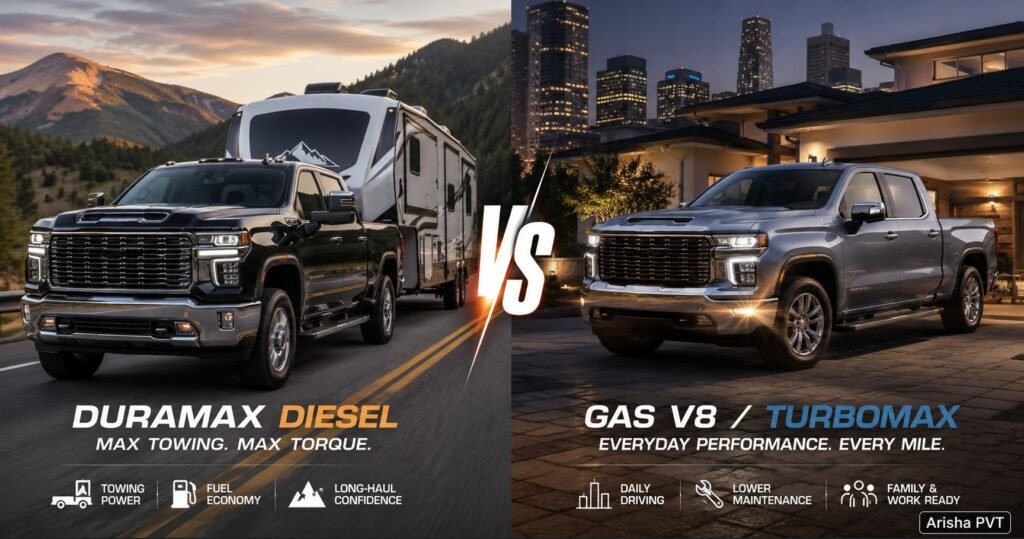
The simple answer: diesel is usually better for frequent towing, long highway trips, stronger low-RPM torque, and better fuel economy under steady driving. Gas engines are usually better for lower ownership complexity, daily driving, shorter trips, easier refueling, and buyers who do not tow heavy trailers often. In the Silverado Diesel vs Gas debate, the Duramax diesel fits long-distance and towing-focused owners, while TurboMax and V8 gas engines fit family, work, city, and mixed-use drivers better.
Table of Contents
Silverado Diesel vs Gas Overview
A proper Silverado diesel vs gas overview starts with understanding truck use. A full-size pickup is not bought for one single reason. Some owners tow a camper every weekend. Some use the bed for tools and materials. Some want a comfortable family truck with a large cabin, safety technology, and road-trip space. Others simply like the strength, ride height, and confidence of a full-size pickup.
Diesel and gas engines approach power differently. A diesel engine is built around torque, efficiency under load, and relaxed highway pulling. A gas engine is usually smoother for short trips, simpler for most drivers, and easier to own if the truck spends most of its life in suburban or city traffic.
This is why there is no one-size-fits-all winner. The best engine depends on your real driving pattern. A diesel Silverado may be excellent for a contractor towing equipment across states, but unnecessary for a driver who mostly goes to school, work, grocery stores, and weekend family activities. A gas V8 may feel more natural to traditional truck buyers, while the TurboMax can be a smart modern option for practical owners who want capability without overbuying.
Duramax, TurboMax, and V8 Engine Choices
Duramax Diesel Engine Explained
The Duramax diesel engine explained in beginner-friendly terms: it is designed to produce strong torque at lower engine speeds. That means the truck does not have to work as hard when pulling a trailer, climbing hills, or cruising on the highway. For many owners, this creates a calm and confident driving experience.
The Duramax diesel is attractive for drivers who regularly tow boats, campers, livestock trailers, landscaping trailers, or work equipment. It can also be useful for long-distance highway drivers because diesel engines often deliver better efficiency when driven steadily over many miles.
The drawback is complexity. Diesel trucks may require diesel exhaust fluid, emissions-system care, different maintenance habits, and potentially higher repair costs. If you only drive short local trips, the diesel advantage may not be as strong. Buyers should also check local diesel fuel pricing, dealership service availability, and official manufacturer maintenance schedules before deciding.
Turbo Max Gas Engine Explained
The Turbo Max gas engine explained simply: it is a turbocharged gas engine designed to give useful torque without requiring a larger V8. It is a modern answer to the needs of daily truck owners who want a capable Silverado but do not always need maximum towing capacity.
The TurboMax can make sense for first-time truck buyers, family drivers, light work users, and people who tow occasionally. It may not have the classic sound or feel of a V8, but it can offer a strong balance of performance, cost, and everyday usability.
In a world where electric vehicles, hybrid vehicles, and smart transportation systems are becoming more common, smaller turbocharged engines show how truck engineering is changing. Automakers are trying to deliver useful power while managing fuel economy, emissions rules, and ownership cost expectations.
V8 Gas Engine Options
The V8 gas engine options remain popular because many American truck buyers still love traditional power. A V8 usually feels smooth, strong, and familiar. It can be a great choice for buyers who tow sometimes, drive on highways often, and want classic full-size truck performance without diesel ownership complexity.
A V8 Silverado may be ideal for drivers who carry passengers, tow a medium trailer, take road trips, and want confident acceleration. It is also easier for many mechanics and dealerships to service compared with more specialized diesel systems.
Fuel Economy Comparison
A realistic fuel economy comparison should look beyond window-sticker numbers. Diesel often performs best on long highway drives, especially when the truck is moving steadily. Gas engines may be less efficient under heavy towing but can be more practical for shorter trips and mixed city use.
If your Silverado spends most of its time on highways, the Duramax may save fuel over time. If your driving is mostly local, stop-and-go, short-distance, or school-and-store trips, a gas engine may be easier to justify. Fuel prices also matter. Diesel may cost more or less than regular gasoline depending on region and season.
| Engine Type | Best Use Case | Pros | Cons |
|---|---|---|---|
| Duramax Diesel | Highway driving, regular towing, long-distance work | Strong torque, efficient cruising, confident towing feel | Higher maintenance complexity, diesel fuel and DEF considerations |
| TurboMax Gas | Daily driving, light work, occasional towing | Practical power, modern gas-engine efficiency, lower complexity than diesel | Not the classic V8 feel, not ideal for frequent heavy towing |
| 5.3L V8 Gas | Balanced family and work use | Smooth power, familiar ownership, strong all-around performance | May use more fuel than diesel on highway towing trips |
| 6.2L V8 Gas | Drivers wanting stronger gas performance | Powerful acceleration, confident towing, premium truck feel | Higher fuel use and often tied to higher trims or packages |
Towing Performance Comparison
A serious towing performance comparison must include more than the maximum tow rating. Real towing depends on trailer weight, tongue weight, payload, passengers, cargo, drivetrain, axle ratio, tires, brakes, hitch setup, and trailering package. A truck that can technically tow a certain number may not feel comfortable or safe if it is overloaded with passengers and cargo.
Diesel engines feel strong because they produce torque early. That helps when starting from a stop with a trailer or climbing long grades. Gas V8 engines can also tow very well, especially when properly equipped. The TurboMax is better for light to medium-duty towing, such as small utility trailers, small campers, ATVs, or home improvement loads.
For road safety, buyers should never choose an engine based on horsepower alone. Trailer brakes, mirrors, camera views, tire pressure, payload rating, and driver confidence matter. Modern Silverado technology, such as trailer camera systems and connected vehicle features, can make towing easier, but they do not replace correct weight calculations.
| Buyer Scenario | Recommended Engine Direction | Why It Makes Sense |
|---|---|---|
| Daily family driving with occasional small trailer | TurboMax or 5.3L V8 gas | Good balance of cost, comfort, and capability without diesel complexity |
| Frequent camper, boat, or work trailer towing | Duramax diesel or properly equipped V8 | Better pulling confidence, stronger highway towing, more relaxed performance |
| Mostly highway miles and long road trips | Duramax diesel | Efficient steady-speed driving and strong low-end torque |
| Traditional truck feel and strong acceleration | V8 gas | Smooth power delivery and familiar gas-engine ownership |
| Short city trips and lower maintenance concern | Gas engine | Simple daily usability and easier ownership for most drivers |
Maintenance Cost Difference
The maintenance cost difference between diesel and gas can become important over years of ownership. Diesel engines are often built for durability, but their systems can be more expensive. Diesel exhaust fluid, fuel filters, emissions components, and specialized diagnostics can increase ownership cost.
Gas engines usually have simpler maintenance routines for everyday drivers. Oil changes, spark plugs, air filters, coolant service, transmission service, and regular inspections are familiar to most repair shops. This does not mean gas trucks are cheap to maintain, but they are often easier for beginners to understand.
For smart car buying, ask these questions before choosing:
- How many miles do you drive per year?
- How often do you tow?
- Do you mostly drive short trips or long highway routes?
- Is diesel fuel easy to find in your area?
- Do local dealerships have strong diesel service support?
- Will you keep the truck long enough to benefit from diesel efficiency?
A common mistake is buying diesel only because it sounds stronger. Another mistake is buying the cheapest gas configuration when your real life involves heavy towing. The right answer sits between budget, use case, maintenance, and safety.
Daily Driving and Long-Term Ownership
Gas engine benefits for daily drivers are easy to understand. Gas engines usually warm up quickly, feel smooth in local traffic, and fit normal refueling habits. For drivers who use their Silverado like a family SUV with a bed, gas may be the best match.
Diesel reliability and long-distance use can be excellent when the truck is driven in the way diesel engines prefer. Long highway trips, regular operating temperature, and consistent maintenance help diesel systems perform well. But diesel may be less ideal for constant short trips where the truck rarely gets fully warmed up.
Long-term ownership also includes resale value, warranty coverage, insurance, tire cost, brake wear, accessories, and technology features. A truck with advanced towing technology, smart driving systems, trailering cameras, and connected services may make ownership easier, but buyers should avoid paying for features they will never use.
Future Automotive Trends
The future of trucks is not only diesel vs gas. Electric vehicles, hybrid vehicles, sustainable mobility, EV charging networks, autonomous technology, smart transportation systems, and future mobility platforms are changing the truck market. Silverado buyers are now comparing traditional engines against electric trucks, hybrid SUVs, family SUVs, and advanced vehicle technology.
Still, diesel and gas trucks remain important because many Americans need range, towing flexibility, easy refueling, and proven work capability. EV trucks are improving, but charging time, towing range, infrastructure, and price remain real considerations for many owners. Over the next few years, buyers may see more hybrid truck technology, smarter trailering systems, improved driver assistance, and better connected vehicle ownership tools.
For now, the Silverado Diesel vs Gas decision remains highly practical. Choose based on your real driving life, not just future hype or maximum numbers.
Practical Expert Insight
The most balanced advice is this: do not buy more engine than you need, but do not underbuy if towing is part of your life. A Silverado is a major purchase, and the engine choice affects fuel cost, confidence, maintenance, resale, and daily comfort.
If you tow heavy and drive long distances, the Duramax diesel deserves serious attention. If you want a daily truck for family, work, and occasional towing, a gas engine may be the smarter and simpler choice. If you want traditional truck feel, the V8 remains appealing. If you want modern gas efficiency and practical strength, the TurboMax is worth a close look.
Before buying, test drive different engines on similar roads. Ask the dealership for the exact towing and payload sticker on the truck you are considering. Check the official manufacturer information, not just online comments. The best Silverado is not the one with the biggest number; it is the one that fits your real life.
FAQ
Is the Silverado diesel better than gas?
The diesel Silverado can be better if you tow often, drive long highway distances, or want strong low-end torque. It is especially useful for owners who pull campers, boats, utility trailers, or work equipment. However, gas engines may be better for daily driving, short trips, lower maintenance complexity, and buyers who do not tow heavy loads regularly. The better choice depends on how you actually use the truck, not only on power ratings.
Which Silverado engine is best for work, towing, family, and highway driving?
For work and frequent towing, the Duramax diesel or a properly equipped V8 gas engine is usually the strongest choice. For family use and mixed driving, the TurboMax or 5.3L V8 can make more sense. For highway driving, diesel can be very appealing because of its relaxed torque and efficiency. For city driving and basic ownership, gas is often simpler. Always compare the exact trim, drivetrain, axle ratio, payload, and tow package before deciding.
Is diesel maintenance more expensive than gas?
Diesel maintenance can be more expensive because diesel engines may require diesel exhaust fluid, fuel filter service, emissions-system care, and specialized diagnostics. Gas engines are usually simpler for most daily drivers and easier to service at many repair shops. That does not mean gas trucks are maintenance-free, but the ownership routine is often more familiar. If you drive enough highway miles and tow often, diesel may still be worth the extra complexity.
Is the TurboMax engine good for daily driving?
The TurboMax gas engine can be a strong daily-driving choice for Silverado buyers who want useful power without stepping into diesel ownership. It is especially practical for commuting, light work, weekend projects, and occasional towing. It may not satisfy drivers who want classic V8 sound or maximum towing strength, but it fits many modern truck owners who want a capable pickup for real-world family and work needs.
Should I buy a diesel truck if I only tow a few times per year?
If you only tow a few times per year, a gas Silverado may be the better choice. Diesel is most useful when towing and long-distance driving are regular parts of your life. For occasional small trailers, moving furniture, camping gear, or home improvement loads, a properly equipped gas truck may offer enough capability with less maintenance complexity. Check the trailer weight, payload, passengers, and cargo before choosing any truck.
How should beginners compare Silverado engines?
Beginners should start with real use, not engine hype. Write down how often you tow, how far you drive, what kind of roads you use, how many passengers you carry, and how long you plan to keep the truck. Then compare engine availability, towing rating, payload sticker, fuel type, maintenance schedule, and dealership support. A test drive is also important because each engine feels different in traffic, highway merging, and low-speed driving.
Final Practical Checklist
- Choose Duramax diesel if you tow often or drive long highway miles.
- Choose TurboMax gas if you want practical daily power with lower complexity.
- Choose a V8 gas engine if you want traditional truck feel and strong performance.
- Check the exact payload sticker on the truck, not just online towing numbers.
- Compare fuel prices in your local area before choosing diesel or gas.
- Ask about maintenance schedules, diesel exhaust fluid, and warranty coverage.
- Test drive more than one engine before buying.
- Do not buy diesel only for image; buy it because your driving pattern supports it.
- Do not underbuy if you tow heavy trailers regularly.
- Confirm all specs with official Chevrolet or dealership information before purchase.
Explore More Chevrolet Silverado Guides
Compare Silverado EV, Trims, Towing, Engines, and Rivals
Use these detailed Chevrolet Silverado buyer guides to compare electric trucks, trim levels,
towing power, off-road models, diesel engines, and Ford F-150 alternatives before choosing your next pickup.
Explore More Chevrolet Silverado Guides
Compare Silverado EV, Trims, Towing, Engines, and Rivals
Use these Chevrolet Silverado buyer guides to compare electric trucks, trim levels, towing power, off-road models, diesel engines, and Ford F-150 alternatives before choosing your next pickup.