Silverado Trail Boss vs ZR2: Which Off-Road Chevy Truck Is Actually Better for You?
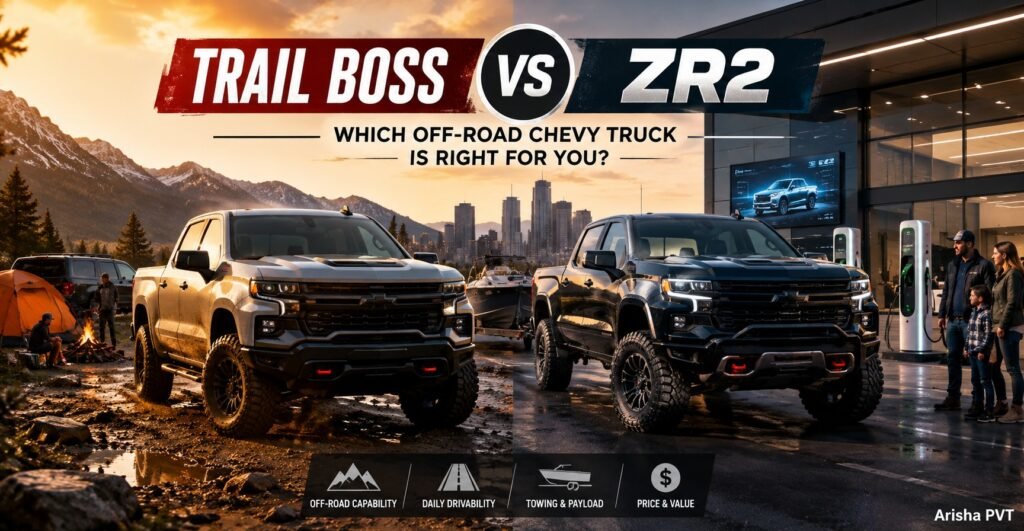
If you are comparing Silverado Trail Boss vs ZR2, you are probably trying to decide between a truck that looks rugged and a truck that is engineered for serious off-road use. In the United States, full-size pickups are no longer just work vehicles. They are family haulers, road-trip machines, towing tools, weekend adventure rigs, and increasingly connected smart vehicles with advanced driving technology.
The Silverado Trail Boss and Silverado ZR2 both sit on the tough side of the Chevy truck lineup, but they serve different buyers. The Trail Boss is the more practical choice for drivers who want factory off-road style, everyday comfort, and useful capability without paying for the most advanced trail hardware. The ZR2 is aimed at buyers who want maximum off-road confidence, stronger suspension hardware, better trail protection, and a more specialized adventure setup.
Quick Answer Box
The Silverado Trail Boss is better for most everyday truck buyers who want rugged looks, light off-road confidence, towing usefulness, and better value. The Silverado ZR2 is better for serious off-road drivers who plan to tackle rocky trails, uneven terrain, mud, ruts, and adventure routes more often. In simple terms, Trail Boss is the smarter daily-use off-road truck, while ZR2 is the more capable trail-focused truck. Always check current manufacturer and dealership details before buying because pricing, packages, and availability can change.
Trail Boss vs ZR2 Overview: What This Comparison Really Means
A proper Silverado Trail Boss vs ZR2 comparison starts with buyer intent. Both trucks are off-road-themed Silverado models, but they are not designed for the exact same lifestyle. The Trail Boss is a factory-lifted, aggressive-looking truck that fits the needs of drivers who want a confident 4×4 pickup for snow, dirt roads, campsites, hunting land, boat ramps, and occasional trails.
The ZR2 is more specialized. Chevrolet describes the 2026 Silverado ZR2 as the peak off-road performer and lists features such as a 2-inch factory suspension lift, Multimatic DSSV dampers, front and rear electronic locking differentials, large underbody aluminum skid plates, an off-road cut front bumper, and 33-inch Goodyear Wrangler Territory MT tires. Chevrolet also lists the 2026 LT Trail Boss at a lower starting price than the ZR2, while the ZR2 starts higher and includes more focused off-road equipment. :contentReference[oaicite:0]{index=0}
This matters because many truck buyers pay for capability they never fully use. A driver in Texas, Colorado, Utah, Michigan, Pennsylvania, or rural California may love the look of an off-road Silverado, but that does not automatically mean the ZR2 is the smarter purchase. For many families and everyday owners, the Trail Boss offers the right mix of confidence, usability, and cost control.
Exterior and Stance Difference
The exterior and stance difference between the Trail Boss and ZR2 is one of the first things buyers notice. The Trail Boss has a bold, lifted appearance that gives it a stronger road presence than a standard Silverado. It looks ready for trails, job sites, bad weather, and weekend travel. For many buyers, that is exactly the point: they want the off-road look without stepping into the most expensive and specialized trim.
The ZR2 looks more purpose-built. Its front bumper design, protective hardware, tire setup, and stance are more serious. It is the truck that visually communicates, “I am built for rough terrain.” If you park both at a dealership, the Trail Boss may look rugged and practical, while the ZR2 looks more aggressive and trail-focused.
Real-world example: if your truck spends most weekdays on highways, school runs, grocery trips, and job-site parking lots, the Trail Boss has plenty of attitude. If your weekends regularly involve rocky trails, remote campsites, deep ruts, steep approaches, and unpredictable terrain, the ZR2’s extra hardware becomes more meaningful.
Suspension and Off-Road Hardware
The biggest difference in Silverado Trail Boss vs ZR2 is not just the badge. It is the suspension and off-road hardware underneath the truck. The Trail Boss gives buyers a more capable factory off-road setup than a regular Silverado, making it useful for gravel roads, mild trails, snowy driveways, farm roads, and camping access roads.
The ZR2 goes further with advanced suspension technology and locking differentials. The Multimatic DSSV dampers are a major part of the ZR2’s identity. They are designed to manage rough terrain better than a standard truck suspension, helping the truck stay more controlled when the surface gets uneven.
Front and rear electronic locking differentials are also important. In beginner-friendly terms, lockers help both wheels on an axle turn together when traction is poor. That can make a big difference when one wheel is on loose dirt, mud, snow, or a rock while the other has more grip. For serious off-road adventure, this is a meaningful advantage.
| Feature | Silverado Trail Boss | Silverado ZR2 | Practical Impact |
|---|---|---|---|
| Off-road purpose | Light to moderate off-road use | Serious off-road adventure | Trail Boss suits most drivers; ZR2 suits frequent trail users |
| Suspension focus | Rugged factory off-road setup | Advanced off-road dampers | ZR2 is better on rough, uneven terrain |
| Locking differentials | Depends on package/spec | Front and rear e-lockers listed by Chevrolet | ZR2 has a stronger traction advantage |
| Underbody protection | Useful for general rugged use | More serious skid plate protection | ZR2 is safer for rocks and trail obstacles |
Tires, Wheels, and Ground Clearance
Tires, wheels, ground clearance, and approach angles are extremely important in off-road driving. A truck can have strong horsepower and impressive technology, but if its tires and clearance are not suited for the terrain, it will still struggle.
Chevrolet lists 33-inch Goodyear Wrangler Territory MT tires for the 2026 Silverado ZR2. That is a clear sign that the ZR2 is designed for rougher terrain than an appearance-focused truck. Ground clearance is another important factor. Third-party specification listings show the 2026 Silverado ZR2 with 11.2 inches of ground clearance, while broader Silverado 1500 data shows ground clearance varying by configuration. :contentReference[oaicite:1]{index=1}
For daily driving, more aggressive tires can create trade-offs. Mud-terrain or aggressive all-terrain tires may produce more road noise, may wear differently, and may cost more to replace. That is one reason the Trail Boss can be the better smart car buying choice for drivers who want capability but do not need maximum trail performance.
Engine Options and Driving Feel
Engine options matter because truck ownership is not only about off-road ability. Buyers also care about acceleration, towing confidence, fuel use, maintenance, and long-term ownership costs. The Silverado lineup includes multiple powertrain choices depending on trim, configuration, and availability. Dealer and manufacturer information should always be checked before signing because engines and packages may vary by model year, region, inventory, and order availability.
In practical terms, the Trail Boss can appeal to buyers who want a strong truck with more flexibility. The ZR2 is often chosen by buyers who are willing to accept some towing, tire, fuel economy, and cost trade-offs in exchange for stronger off-road hardware.
If you are a beginner truck buyer, do not shop by horsepower alone. Ask these questions:
- Will you tow a camper, boat, utility trailer, or work trailer?
- Will the truck carry family passengers every week?
- Will most of your driving happen on pavement?
- Do you need off-road protection or just off-road appearance?
- Are you prepared for higher tire and maintenance costs?
Daily Driving Comfort: Which Truck Is Easier to Live With?
Daily driving comfort is where many buyers should slow down before choosing the more extreme truck. The ZR2 may be the more exciting option, but excitement does not automatically equal better ownership. If your Silverado is your only vehicle, it needs to handle commuting, parking, family errands, highway trips, bad weather, and long-distance travel.
The Trail Boss usually makes more sense for drivers who want the lifted look and 4×4 capability while keeping the truck practical. It feels more like a rugged everyday pickup than a specialized trail machine. For families, that can be important. A truck used for school drop-offs, sports practice, road trips, and home improvement runs should not feel like a compromise every day.
The ZR2 can still be comfortable, especially with modern interiors, connected vehicle features, driver-assistance systems, large displays, and premium cabin technology. Chevrolet’s 2026 Silverado page highlights advanced technology across the lineup, including large screen availability on higher trims and multiple camera views on certain models. :contentReference[oaicite:2]{index=2}
Towing and Payload Difference
The towing and payload difference is one of the most practical parts of the Silverado Trail Boss vs ZR2 decision. Chevrolet lists the 2026 Silverado 1500 lineup with up to 13,300 pounds of maximum towing when properly equipped, but that does not mean every trim, engine, cab, bed, axle, and package combination can tow that amount. :contentReference[oaicite:3]{index=3}
The ZR2’s specialized off-road setup can reduce towing and payload compared with more towing-focused Silverado configurations. A ZR2 specification listing shows a maximum towing capacity of 8,800 pounds and a maximum payload of 1,550 pounds for a listed 2026 configuration. :contentReference[oaicite:4]{index=4}
This is why serious buyers should check the actual door-jamb trailering label on the truck they plan to buy. Chevrolet’s trailering guide notes that the label provides vehicle-specific information such as GVWR, GCWR, GAWR, maximum payload, maximum tongue weight, and curb weight. That is more reliable than assuming every truck with the same badge has identical capability. :contentReference[oaicite:5]{index=5}
| Buyer Scenario | Better Choice | Why It Makes Sense |
|---|---|---|
| Daily driving with occasional dirt roads | Trail Boss | Better balance of rugged style, comfort, and value |
| Frequent rocky trail driving | ZR2 | Stronger suspension, protection, and traction hardware |
| Family truck with weekend camping | Trail Boss | Practical for mixed use without overbuying |
| Remote adventure routes | ZR2 | More confidence on difficult terrain |
| Maximum towing priority | Check other Silverado configurations | Off-road trims may not offer the highest tow rating |
Price and Value Comparison
The price/value comparison is where the Trail Boss becomes very attractive. Chevrolet’s 2026 Silverado 1500 page lists the LT Trail Boss starting lower than the ZR2, while the ZR2 starts significantly higher and includes more serious off-road equipment. :contentReference[oaicite:6]{index=6}
That price gap matters because ownership costs do not stop at the dealership. Insurance, tires, fuel, accessories, maintenance, financing, registration, and resale value all affect the real cost of ownership. If you are buying a truck mainly for appearance and occasional trail use, the Trail Boss may leave more room in your budget for useful accessories such as bed covers, floor liners, recovery boards, cargo systems, dash cameras, towing mirrors, or upgraded all-weather tires.
The ZR2 offers more built-in capability, but you should buy it because you need or truly want that capability. Paying extra for hardware you rarely use can be exciting at first but less satisfying after years of higher costs.
Maintenance Considerations and Long-Term Ownership Impact
Off-road trucks need more thoughtful maintenance than regular commuter vehicles. Dirt, mud, gravel, snow, road salt, and trail impacts can affect brakes, suspension parts, underbody components, tires, alignment, and fluids. Whether you choose Trail Boss or ZR2, proper maintenance protects your investment.
Smart Ownership Tips
- Wash the underbody after mud, salt, or beach driving.
- Inspect tires for cuts, uneven wear, and embedded rocks.
- Check alignment after hard trail use or pothole impacts.
- Inspect skid plates, suspension parts, and brake lines after rough terrain.
- Use the correct tire pressure for highway driving and follow safe guidance for off-road situations.
- Do not exceed payload, tongue weight, or towing limits.
The ZR2 may require more attention if it is used as intended. More serious off-road equipment is valuable, but it also means owners should be more disciplined about inspections. The Trail Boss can be easier for many owners because it delivers rugged utility without feeling as specialized.
Future Automotive Trends: Where Off-Road Trucks Are Going
The future of off-road trucks is changing quickly. Electric vehicles, hybrid vehicles, smart driving systems, advanced camera views, connected vehicle data, over-the-air software updates, and driver-assistance features are reshaping truck ownership. Silverado buyers are already seeing this shift across the wider truck market, including the rise of electric trucks and off-road EV variants.
Future off-road trucks may use electric torque, smarter traction systems, autonomous technology support, advanced trail cameras, and sustainable mobility features to make adventure driving easier and safer. EV charging infrastructure will also matter more as electric pickups become more common. For now, gas and diesel full-size trucks still dominate many towing and off-road use cases, but future mobility is clearly moving toward smarter and more connected trucks.
For buyers comparing Silverado Trail Boss vs ZR2, this means technology should be part of the decision. Look at camera systems, safety features, infotainment, trailer technology, smartphone integration, and driver-assistance tools—not just tires and lift height.
Practical Expert Insight
The most realistic advice is simple: buy the truck for how you actually drive, not how you imagine the truck in a commercial. The Trail Boss is the better fit for a large number of US buyers because it gives them rugged styling, useful 4×4 capability, and a more balanced ownership experience. It is the truck for light off-road use, road trips, job sites, snowy areas, outdoor hobbies, and family duty.
The ZR2 is the better fit when off-road performance is not just a style preference but a real requirement. If you regularly drive rocky trails, remote routes, steep terrain, or difficult surfaces, the ZR2’s suspension, tires, lockers, and protection can justify the higher price.
The common mistake is assuming the most expensive off-road truck is automatically the best truck. The best choice is the one that matches your roads, budget, towing needs, passengers, maintenance comfort, and long-term ownership plan.
FAQ: Silverado Trail Boss vs ZR2
1. Is the Silverado ZR2 better than the Trail Boss?
The Silverado ZR2 is better for serious off-road adventure because it has more specialized trail hardware, including advanced suspension components, stronger underbody protection, and locking differential capability listed by Chevrolet. However, “better” depends on how you drive. For daily commuting, family use, towing flexibility, and occasional dirt-road driving, the Trail Boss may be the smarter choice. If you only go off-road a few times a year, the ZR2 may be more truck than you need.
2. Which is best for light off-road use?
The best choice for light off-road use is usually the Silverado Trail Boss. It gives you the rugged look, elevated stance, 4×4 confidence, and practical capability most casual outdoor drivers need. It is well suited for gravel roads, camping areas, snow, wet grass, mild trails, and job-site access. It also makes more sense if your truck spends most of its time on pavement. For many buyers, this balance makes it a stronger value than paying more for the ZR2.
3. Which is best for serious off-road adventure?
The best choice for serious off-road adventure is the Silverado ZR2. It is the more specialized off-road truck, with stronger trail-focused hardware and better confidence on rough terrain. If your driving includes rocky trails, uneven surfaces, deep ruts, remote camping routes, or difficult outdoor conditions, the ZR2 makes more sense. The extra cost becomes easier to justify when you regularly use the suspension, tires, lockers, and protection that separate it from the Trail Boss.
4. Is the Trail Boss better for towing?
The answer depends on the exact configuration. Off-road trims are not always the highest-towing versions of a truck. The Trail Boss may be a better towing fit for some buyers because it is less specialized than the ZR2, but you should never assume based only on trim name. Check the specific truck’s trailering label, engine, axle ratio, cab, bed, payload rating, and towing package. For heavy towing, compare other Silverado configurations as well.
5. Is the ZR2 comfortable enough for daily driving?
Yes, the ZR2 can be comfortable enough for daily driving, especially because modern trucks include better cabins, technology, screens, cameras, and safety systems than older off-road vehicles. However, it may still feel more specialized than the Trail Boss. Aggressive tires, off-road suspension tuning, and higher ownership costs may matter over time. If your driving is mostly highway and city use, test-drive both trucks before deciding.
6. Should beginner truck buyers choose Trail Boss or ZR2?
Beginner truck buyers should usually start with the Trail Boss unless they already know they need serious off-road capability. It is easier to justify financially, more practical for everyday life, and still rugged enough for many outdoor situations. The ZR2 is excellent, but it is best for buyers who understand off-road driving needs and are comfortable with the cost and maintenance expectations of a more specialized truck.
Final Practical Checklist
- Choose Trail Boss if you want rugged looks, everyday comfort, and light off-road confidence.
- Choose ZR2 if you regularly drive serious trails, rocks, ruts, mud, or remote adventure routes.
- Check the exact truck’s towing and payload label before buying.
- Compare tire replacement costs before choosing the more aggressive setup.
- Test-drive both trucks on normal roads, not just around the dealership lot.
- Think about passengers, parking, road noise, fuel use, insurance, and maintenance.
- Do not buy more off-road truck than your real lifestyle requires.
- Check official Chevrolet and dealership information for current pricing, packages, and availability.
Explore More Chevrolet Silverado Guides
Compare Silverado EV, Trims, Towing, Engines, and Rivals
Use these detailed Chevrolet Silverado buyer guides to compare electric trucks, trim levels,
towing power, off-road models, diesel engines, and Ford F-150 alternatives before choosing your next pickup.
Explore More Chevrolet Silverado Guides
Compare Silverado EV, Trims, Towing, Engines, and Rivals
Use these Chevrolet Silverado buyer guides to compare electric trucks, trim levels, towing power, off-road models, diesel engines, and Ford F-150 alternatives before choosing your next pickup.